How a Life Sciences Organisation Stopped Re-Handling the Same Information and Built a Reusable, Traceable Data Foundation Across Site Feasibility, Trial Documentation and External Data
- Site capability information structured once and reusable across studies
- Study requirements matched against documented site capabilities, with gaps clearly flagged
- Missing, duplicate and outdated trial documents surfaced early through exception reporting
- Inconsistent names, dates, organisations and identifiers standardised across sources
- A single pipeline from source to validated, structured data, with full traceability
- Human review built into every critical step, not added afterwards
The Situation
Clinical research runs on information. Before a trial starts, sponsors and CROs must establish whether each research site can actually conduct the study. That means understanding its investigators and research teams, therapeutic-area experience, laboratory and diagnostic capabilities, equipment, patient population, recruitment ability and previous trial history. Once the trial is running, every site, study and sponsor generates a growing body of essential documentation that must remain complete, consistent and retrievable.
Our client, a life sciences organisation working across clinical operations and external research data, had plenty of this information. The problem was that none of it was organised for reuse.
Site details lived in feasibility questionnaires, spreadsheets, documents and separate internal systems. Trial documents sat in fragmented repositories with inconsistent metadata. Valuable external information, including clinical publications, conference abstracts, trial records, scientific PDFs, regulatory documents and healthcare professional profiles, arrived in mixed formats from many sources. Teams spent more of their time handling information than using it.
The pattern is common across the industry. In an Advarra site feasibility survey, only 34.7% of surveyed sites reported having a site information packet containing reusable capability information. Most sites therefore answer similar questions again and again, and sponsors receive records that are hard to compare.
The Core Problem
The organisation's challenge was not a shortage of data. The data could not be used where it was.
Three connected problems kept appearing:
- 1. Site feasibility was repetitive and inconsistent: Each new study triggered another round of questionnaires. Similar questions were answered repeatedly, capability records differed between sources, and feasibility reviewers often found missing or outdated information at the point of decision. Comparing sites meant manually reconciling documents that were never designed to be compared.
- 2. Trial documentation was stored but not reconciled: Holding a file is different from knowing the record is complete and correct. Teams had to find missing essential documents, duplicate or outdated versions, incorrect classifications and inconsistent study or site metadata, often by hand. Records were difficult to locate, and the gap between expected and available documentation was hard to see until late in the process.
- 3. External life sciences data was a manual processing job: Extracting information from hundreds of documents, standardising names and identifiers, matching records across sources, resolving conflicts and tracking changes had turned what should be data collection into a continuous manual workflow.
Underneath all three was the same root cause. Information was unstructured, inconsistently labelled and disconnected, so systems and analysts could not rely on it without rework.
There was a further constraint. This is regulated clinical research, so any solution had to support human judgement and be fully traceable, not replace it.
Objectives
- Structure site capability information once and make it reusable across studies, instead of re-collecting it for every feasibility request.
- Standardise investigator, infrastructure, equipment, experience and capability records into consistent profiles that can be compared across sites.
- Match documented capabilities against specific study requirements, and make the gaps visible.
- Make trial documentation review-ready by detecting missing documents, duplicates, version discrepancies, misclassifications and metadata inconsistencies early.
- Turn external and unstructured sources into usable datasets that integrate with databases, analytics workflows and business systems.
- Keep humans in control. Every uncertain, missing or conflicting item would be routed to a reviewer rather than resolved silently.
Our Approach
We designed one pipeline with a shared foundation and three workstreams, rather than three separate tools:
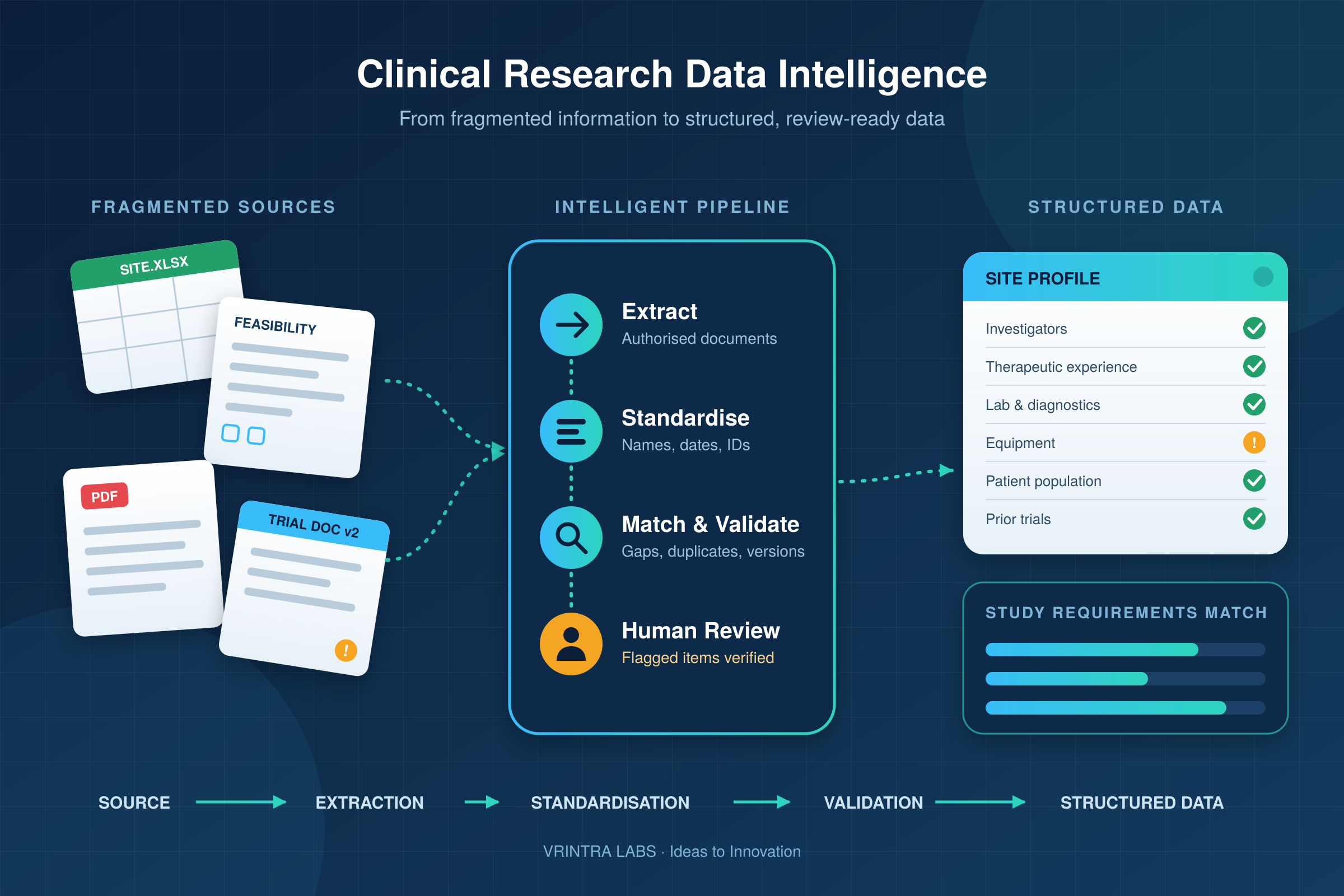
Before designing anything, we mapped how information actually moved. We catalogued the questionnaires, spreadsheets, documents, repositories and external sources involved, along with the internal systems that held fragments of the same facts. We documented which records were authorised for use, who owned each source, how each data element was defined, and where the same fact appeared in conflicting forms. This produced a shared data dictionary and a clear definition of what "complete" and "current" should mean for site profiles and trial documentation.
Phase 2: Governed ExtractionWe built extraction pipelines that read authorised documents and questionnaires and pull out structured information: investigators and teams, therapeutic-area experience, laboratory and diagnostic capabilities, equipment and infrastructure, patient population and recruitment capability, and previous trial experience. For the document workstream, extraction covered document content and metadata. For external sources, it covered publications, abstracts, trial records, regulatory documents, spreadsheets and professional profiles. Every extracted value keeps a link to its source document and location, so any data point can be traced back and checked.
Phase 3: Standardisation and Entity ResolutionExtraction alone produces messy data, so the next layer normalises it. Names, dates, organisations and identifiers were put into consistent formats. Records describing the same investigator, site, organisation or study across different sources were matched and linked. Documents were classified and metadata standardised against agreed definitions. This layer turned a pile of inconsistent records into one coherent view of each site, study and document set.
Phase 4: Reusable Site Profiles and Requirement MatchingStandardised site information was organised into structured, reusable profiles. When a new study arrived, its requirements were matched against each site's documented capabilities. The output was a clear view of where a site fits, where evidence is missing, and where information conflicts or looks out of date. The system supports the feasibility conversation, and the clinical feasibility decision stays with the people who make it.
Phase 5: Documentation Intelligence and Exception ReportingFor trial documentation, we compared the documents that exist against the documents expected. The pipeline detects missing essential documents, duplicate records, outdated versions, version discrepancies, incorrect classifications and inconsistent study or site metadata. Rather than leaving teams to find these issues by searching, the system produces exception reports that direct reviewers to exactly what needs attention.
Phase 6: Validation and Human ReviewValidation rules check completeness, consistency and plausibility before data is treated as reliable. Anything missing, inconsistent, ambiguous or out of date is flagged and routed to a human reviewer, with the source evidence alongside it. Reviewer decisions are recorded, which creates an audit trail and gives the pipeline a source of corrections to learn from. Automation handles the repetitive handling. People handle the judgement.
Phase 7: Delivery into Existing SystemsValidated data was exposed as structured, searchable datasets that integrate with the organisation's databases, analytics workflows and business systems. Change tracking across external sources means the data stays current instead of going stale after the first load.
Technology Foundation
The solution combined data engineering and intelligent automation: document ingestion and parsing, intelligent information extraction, entity matching and standardisation, rule-based validation, workflow orchestration and structured storage with search. Technology choices were made to fit the client's environment and governance requirements.
Results
- Site information became reusable: Site capability data is structured once into consistent profiles, so teams no longer rebuild the same answers for every feasibility request.
- Sites became comparable: Standardised investigator, infrastructure and capability records allow like-for-like comparison across research sites.
- Feasibility matching became evidence-based: Study requirements are checked against documented capabilities, with missing and conflicting information clearly flagged before review, not discovered during it.
- Documentation gaps surfaced earlier: Missing documents, duplicates, version discrepancies and metadata errors appear in exception reports instead of being found late.
- Records became easier to find: Consistent classification and metadata turned fragmented repositories into searchable, review-ready information.
- External data became usable: Information from publications, abstracts, trial records, regulatory documents and other sources now arrives as validated, structured datasets that can flow straight into analytics and business systems.
- Oversight was strengthened, not reduced: Every extracted value is traceable to its source, and every exception goes through human review with a recorded decision.
Key Takeaway
The next data advantage in life sciences may not come from collecting more information. It may come from making the information you already have, and the information you need, usable.
Technology can support the process. Human oversight remains essential, especially in regulated clinical research environments.